You’ve got a logo that looks sharp on your screen. Maybe it’s a team name, a company mark, or something you sketched at the kitchen table. Then someone asks if you want it stitched, woven, or made from rubber, and you realize you have no idea. Sewn on or ironed on? Big or small? It gets confusing fast, and every choice changes how the patch looks and how long it lasts.
This guide walks you through the types of custom patches so you can choose without second-guessing. If you’re totally new to patches, start with our beginner’s guide to custom patches in Canada.
13 Types of Custom Patches and Their Uses
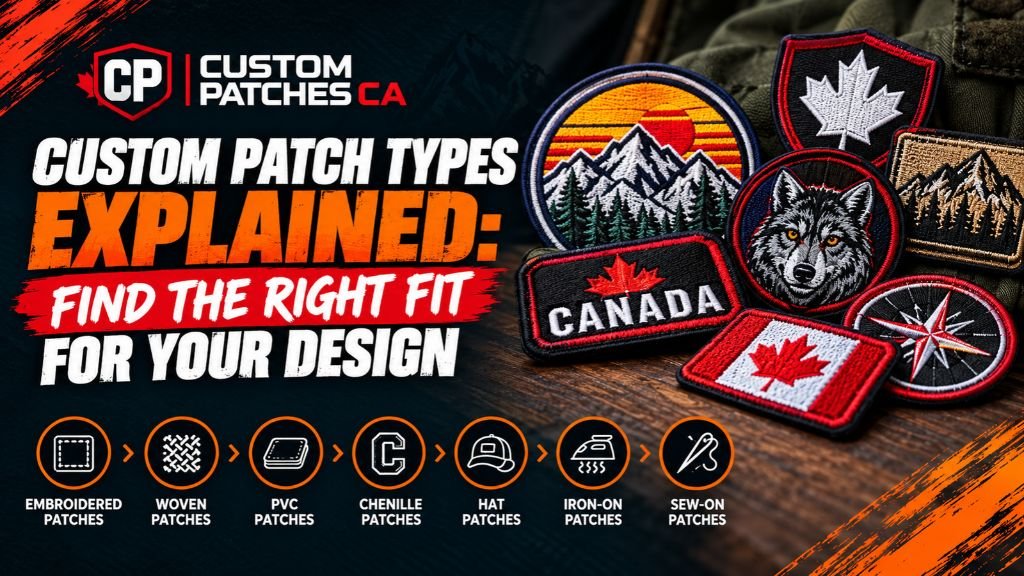
Below are the custom patch types Canadian buyers ask about most. Some get their name from how they’re made, like embroidered, woven, PVC, and chenille. Others are named for where they end up, like motorcycle, military, and jersey patches. Sew-on, iron-on, and Velcro describe how the patch attaches. Yes, they overlap. Most real orders borrow from two or three of them, so don’t stress over the categories.
1. Embroidered Patches
Embroidered patches are what most people picture when they hear the word “patch.” Thread is stitched onto a fabric base to build up your design, and the finished piece has a real hands-on look. They’ve been around for decades, which is a big part of why people trust them. If you want something familiar that never feels out of place, this is a safe place to begin.
- Best for. Uniforms, jackets, hats, and traditional logos.
- Key benefits. The stitching sits up from the fabric, so you get a raised texture and a proper embroidered finish. Colours look rich, and the patch works on almost any fabric.
Order your custom embroidered patches today and give your logo a polished finish.
2. Motorcycle Patches
Motorcycle patches tend to be big. Picture the full back piece on a leather vest, the kind that shows off a club name and crest from across a parking lot. They’re made to live outdoors, so wind, rain, and sun don’t bother them much. Riders usually want a lot of detail packed in, and the larger size gives the artwork room to breathe.
- Best for. Leather vests, riding jackets, club colours, and rally or event gear.
- Key benefits. They handle weather well, and big designs keep their small details.
Get a quote for your club patches and see your crest at full size.
3. Varsity Jacket Patches
Varsity jacket patches are the large letters and emblems you see on school and team jackets. They carry a lot of history, so a good one makes a jacket feel like it belongs to a team the second you put it on. Alumni groups and graduating classes order them often too. Since they’re so large, the shape and colours matter more than tiny details.
- Best for. Varsity jackets, letterman jackets, alumni gear, and team apparel.
- Key benefits. They give that classic school look, and strong colour contrast makes them easy to spot from across a gym.
Start your varsity patch design and make the jacket yours.
4. Sew-On Patches
Sew-on patches are named for how they attach. You stitch them to your garment by hand or machine, which takes a little time but pays off. It’s the old reliable method, and plenty of people stick with it for that reason. If a jacket or bag is going to be used hard, this is the backing that makes the most sense.
- Best for. Heavy fabrics, bags, uniforms, and anything that gets washed a lot.
- Key benefits. This is the most lasting way to attach a patch. It stays put through hard wear.
Order custom sew-on patches that will last as long as the jacket does.
5. Military Patches
Military patches cover unit insignia, rank, and commemorative designs. These designs often include tiny crests and thin lettering, so the detail has to come out clean. Cadet groups and collectors order them a lot, along with people outfitting tactical gear. They’re made to be worn hard and still look right.
- Best for. Cadet groups, tactical gear, unit identification, and commemorative pieces.
- Key benefits. Fine lines stay sharp, and the patches take rough use without fading fast.
Ask for a quote on custom unit patches.
6. PVC Rubber Patches
PVC rubber patches are a different animal. Instead of thread, they’re moulded from soft rubber, which gives them a glossy, three-dimensional feel you can run a finger over. You’ll see them a lot on outdoor and workwear brands. If you want your logo to stand out and shrug off bad weather, PVC is worth a serious look.
- Best for. Outdoor gear, bags, workwear, tactical kits and branded merchandise.
- Key benefits. They’re waterproof, bendy, and very tough. Of all the custom patch materials, PVC is the one to pick when rain, mud, or heavy use is part of the plan. It also gets through plenty of washing and holds sharp detail.
Request a PVC patch quote today.
7. Hats and Caps Patches
Hat and cap patches are smaller than most, and that changes how you design them. A front panel only has so much room, so the logo needs to stay simple and easy to read. Businesses love them for branded giveaways, and teams use them to get matching headwear. Done right, a small patch can say a lot.
- Best for. Branded headwear, team caps, and promo giveaways.
- Key benefits. They stay compact but clear, so your logo reads well even on a small front panel.
Order patches for your next batch of caps.
8. Woven Patches
Woven patches are made with very fine thread, so the surface comes out flat and smooth. That lets them show small text and thin lines that would turn fuzzy in regular embroidery. If your artwork is busy, woven is usually the fix. They’re also light, so you barely notice them on a shirt.
- Best for. Detailed logos, small text, clothing labels, and complex artwork.
- Key benefits. They hold fine detail well and feel soft on the fabric. They’re a good pick when your design has thin lines that embroidery might blur.
Start your woven patch order today.
9. Name Patches
Name patches are the simplest of the bunch, and often the most used. They carry a person’s name or job title and nothing else. This keeps them clean and easy to read. Workplaces, schools, and sports groups usually order them in batches. Once the layout is set, adding new names later is quick.
- Best for. Work uniforms, scrubs, jackets, and school or team apparel.
- Key benefits. They’re easy to read and quick to personalize, even for a big group.
Order your name patches now and get everyone sorted.
10. Chenille Patches
Chenille patches are soft and a little fuzzy, made from looped yarn. If you’ve ever seen a big felt letter on a letterman jacket, you already know the look. They feel cozy and a bit vintage, and people notice them right away. They’re often paired with felt to build that layered letter style.
- Best for. Letterman jackets, school logos, sports teams, and fashion pieces.
- Key benefits. They have a plush feel and a vintage look that stands out on a jacket.
Get your chenille design quoted and see it come to life.
11. Jersey Patches
Jersey patches go on sports shirts. Team crests, sponsor logos, and captain badges are the usual ones. Jerseys stretch and move a lot, so the patch has to be light and flexible enough that it doesn’t pull on the fabric. Leagues and clubs often order a full set so everyone on the roster matches.
- Best for. Hockey, soccer, and baseball teams, leagues, and club apparel.
- Key benefits. They’re light, they move with stretchy fabric, and they keep team branding sharp.
Order jersey patches for your team this season.
12. Iron-On Patches
Iron-on patches have a heat-activated glue on the back. You press them with a regular iron, and they stick, no needle required. That makes them a favourite for quick projects, kids’ clothes and anyone who just doesn’t like sewing. They do have limits though, especially on fabrics that get washed a lot.
- Best for. Quick DIY jobs, denim, bags and casual wear.
- Key benefits. They go on fast with no sewing. For clothes you wash often, a few stitches around the edge will keep them in place longer.
Order iron on patches and skip the needle.
13. Velcro Patches
Velcro patches have a hook-and-loop backing, so they grab onto a matching panel on your gear. You can pull them off and put them back whenever you like. That’s handy if you swap patches often or want to remove them before washing a jacket. Tactical and uniform users like them for exactly that reason.
- Best for. Tactical gear, uniforms, bags, and badges you swap often.
- Key benefits. You can take them off and reuse them whenever you like.
Get Velcro patches made for your gear.
How to Choose the Right Custom Patch Type
Still wondering which type of custom patch is best for my design? There’s no single right answer. A patch for a hockey jersey has different needs than one for a work jacket. Before you pick from the types of custom patches above, think about these points.
- Design detail. Fine lines and small text work best on woven patches. Bold shapes and simple logos suit embroidery.
- Use and wear. Outdoor and heavy use points to PVC or a sew-on backing.
- Attachment. Sew on, iron on or Velcro depends on the garment and how long the patch needs to stay.
- Look and feel. Raised, flat, glossy, or fuzzy. Browse the custom patch styles above and picture each one on your garment.
- Budget and quantity. Size, stitch count, and order size all change the price. Our post on how much custom patches cost in Canada breaks it down.
Once you have a shortlist, comparing the types of patches side by side gets much simpler. You can also mix styles, like a woven patch with a Velcro back. When you’re ready to move forward, the step-by-step ordering guide shows exactly how it works.
Explore Custom Patches Today with CustomPatchesca
If you’ve read this far, you probably have a few styles in mind already. CustomPatchesca is where you can look through all of them in one place, from embroidered and woven to PVC, chenille and Velcro. You pick the size, the colours and the backing, send in your design, and place your order. Whether you need ten patches for a small club or a few hundred for a company uniform, orders are shipped to addresses across Canada.
Ready to get started? Order custom patches online and upload your design.
Not sure which material or size fits? Contact us, and we’ll help you sort it out and send a free quote.
Conclusion
This detailed guide explains the types of custom patches you can choose from; each have their own look, feel and best use. Embroidered gives texture, woven gives detail, PVC handles rough weather, and chenille adds a soft, vintage touch. Pick the one that suits your design, your garment, and how often it will be worn and washed. Get that right, and the patch will look good for years.
FAQs
1. What are the different types of patches?
Embroidered, woven, PVC, chenille, and leather are the common ones. Sew-on, iron-on, and Velcro are just ways to attach them.
2. Which type of custom patch lasts the longest?
There isn’t one clear winner. PVC copes well with rain, and sew-on embroidered patches handle washing nicely.
3. Do iron-on patches stay on, or should you sew them?
For a bag or denim jacket, iron-on is often fine. If it gets washed weekly, a few stitches around the edge help.
4. What is the minimum order for custom patches in Canada?
It depends on the patch and the seller. Some start at 10 or 20 pieces, and PVC often needs more. Check before you order.
5. Which custom patch type is best for business logos and uniforms?
Many businesses pick embroidered because it looks neat and survives washing. Woven can suit tiny text better.
